
No products in the cart.
If you’re reading this, you’ve probably already decided that the CAIA charter is worth pursuing. You understand the direction the investment industry is heading — private equity, real assets, hedge funds, digital assets — and you want the credentials to match. The question isn’t whether to sit for the exam. The question is how to prepare for it without sacrificing the rest of your life in the process.
This guide is built for working professionals: analysts, portfolio managers, and finance professionals across the MENA region and beyond who are preparing for the September 2026 CAIA Level I exam window while managing full-time roles.
What You’re Actually Up Against
The 2026 CAIA Level I curriculum spans three volumes and 226 learning objectives across eight topic areas:
The CAIA Association recommends that candidates invest over 200 hours of study per level. The material is genuinely substantive, and up to 30% of the exam involves quantitative questions requiring a dedicated financial calculator (TI BA II Plus or HP 12C).
The volume isn’t designed to be punishing. It reflects the actual breadth of the alternative investment landscape. But it does mean you need a strategy — not just discipline.
The Core Problem: Reading Everything Is the Wrong Goal
Most candidates make the same mistake: they treat the CAIA exam like a textbook course and try to read every chapter front to back. This is understandable but inefficient.
The CAIA exam is structured around learning objectives. Every question on the exam links back to at least one specific LO. That means your preparation should be LO-centric — not page-count-centric.
1. Anchor your study plan to the LOs, not the chapters. Each of the 226 learning objectives tells you exactly what you need to know and be able to do. If a concept doesn’t connect to an LO, it will not appear on the exam.
2. Prioritize topic areas by exam weight. Not all eight topics carry equal weight. Time allocation should reflect the actual distribution of exam questions, not the size of the chapter.
3. Use study notes as a filter, not a shortcut. High-quality structured notes mapped directly to learning objectives allow you to cover the conceptual landscape faster — leaving more of your study hours for active practice.
The Most Challenging Topics in the 2026 Curriculum
CAIA Ethical Principles (Topic 1): Tested with nuance. Ethics questions don’t just ask you to define standards — they present scenarios where multiple responses seem defensible. The exam tests professional judgment, not rote recall.
Hedge Fund Strategies (Topic 6): Conceptually dense. Key areas include alpha/beta analysis, statistical fallacies in performance evaluation, and strategy-specific risk profiles.
Real Assets (Topic 3): Quantitatively demanding. Infrastructure valuation, commodity markets, and real estate frameworks all require fluency with specific metrics and models.
Private Equity (Topic 4): Requires understanding of fund structures, return attribution (IRR, MOIC, DPI, RVPI), and the distinction between various buyout strategies.
Digital Assets (Topic 7): Blockchain fundamentals, token classification, DeFi protocols, and smart contracts are tested in a conceptual framework requiring more than surface-level familiarity.
A Study Framework for Full-Time Professionals
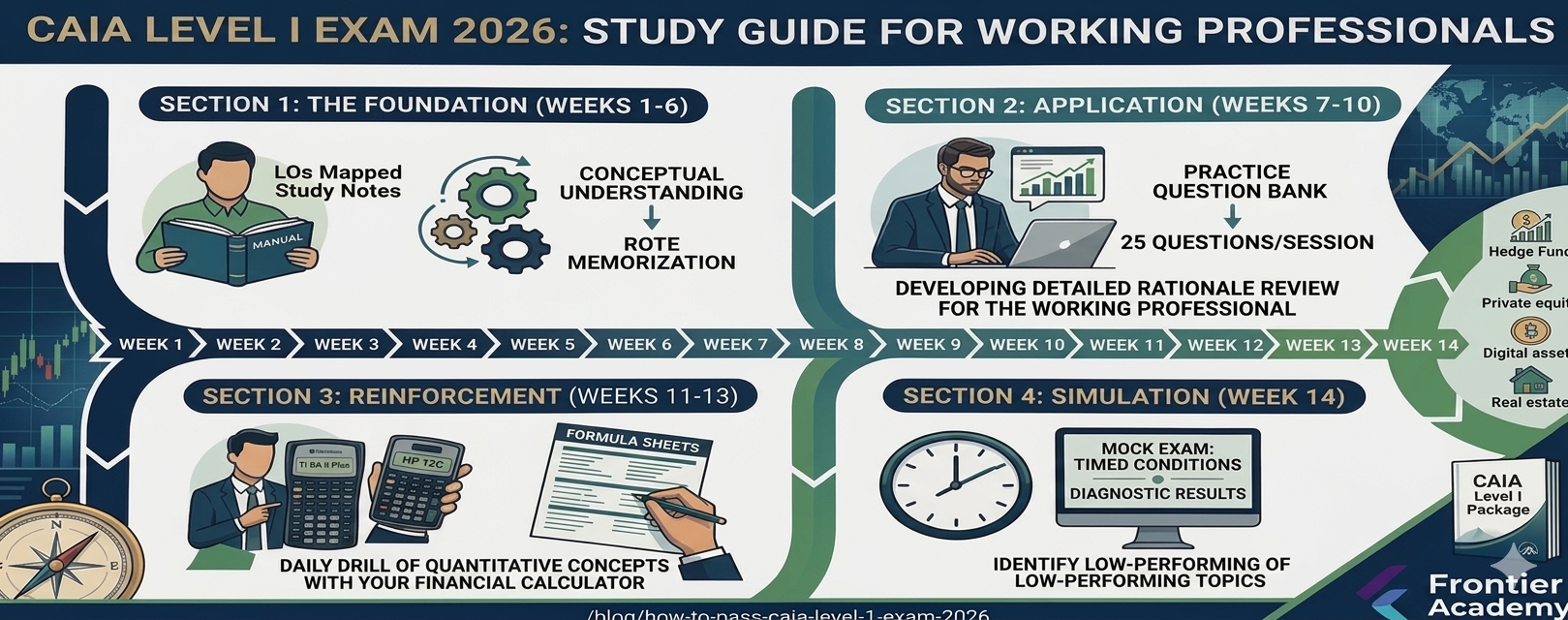
If you’re working full-time and have roughly 14–16 weeks before the September window:
Weeks 1–6 (Foundation): Work through structured study notes for all eight topics. Focus on understanding frameworks and key concepts for each LO. Do not attempt to memorize — understand.
Weeks 7–10 (Application): Begin active practice with a question bank. Target 15–25 questions per session, with full review of rationales — not just right/wrong scoring.
Weeks 11–13 (Reinforcement): Drill formula sheets daily. For quantitative topics, consistent exposure to actual calculations is more effective than re-reading explanations.
Week 14 (Simulation): Sit for a full-length mock exam under timed conditions. Use the diagnostic results to identify your lowest-performing topic areas.
The Preparation Tools That Matter
Frontier Academy offers a complete CAIA Level I preparation package for the September 2026 exam window, including study notes, a question bank, formula sheets, a full-length mock exam, and on-demand instructor support.
Questions? Contact us by email: academy@frontier-me.com


Not a member yet? Register now
Are you a member? Login now