
لا توجد منتجات في سلة المشتريات.
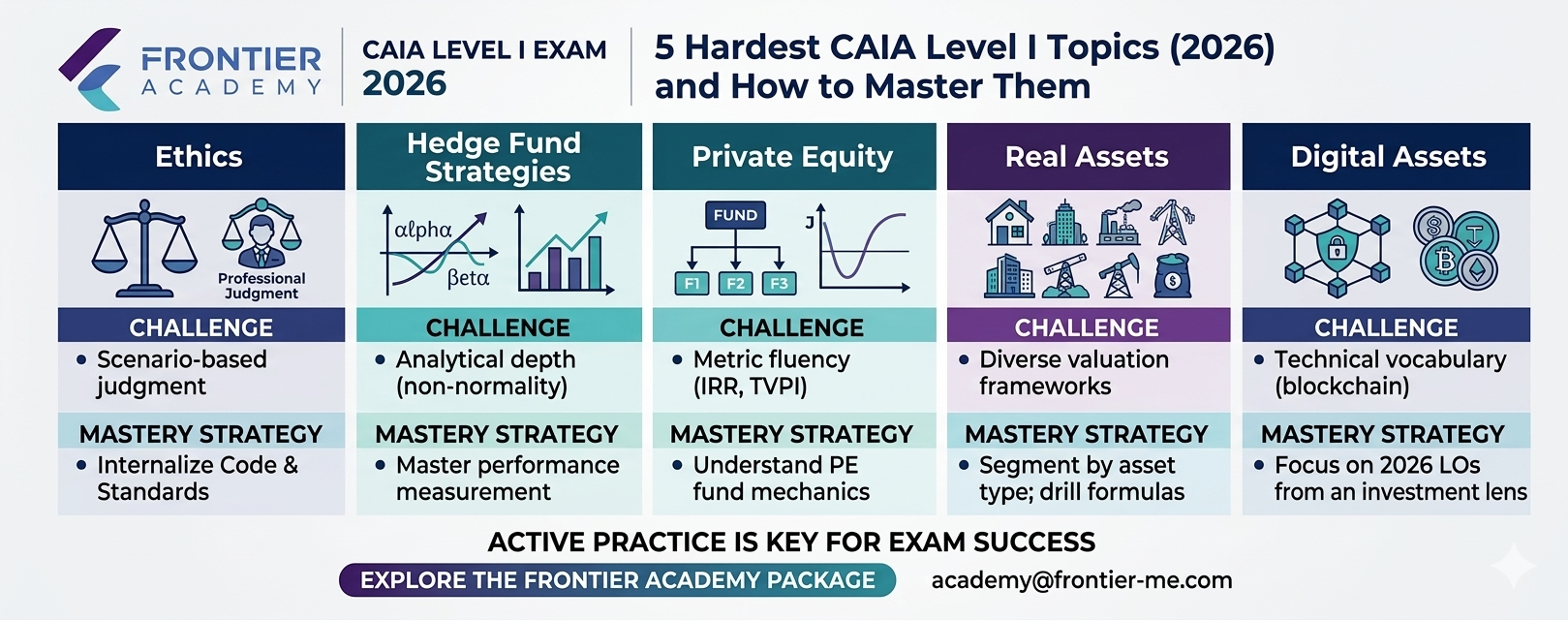
Every CAIA Level I candidate hits a wall. Usually it’s around week four or five, when the initial momentum has worn off and the full weight of the curriculum starts to register: three volumes, 226 learning objectives, topics ranging from commodity markets to blockchain consensus mechanisms to hedge fund alpha attribution.
The good news: not all topics are equally difficult, and not all difficulty is equal. Here’s a clear-eyed breakdown of the five areas where candidates most commonly struggle — and what to do about each one.
1. CAIA Ethical Principles — The Trap of Underestimating It
Ethics questions don’t reward memorization. They require professional judgment across realistic scenarios where multiple responses appear defensible.
Many candidates treat Ethics as a warm-up topic and give it proportionally less study time than topics like Private Equity or Hedge Funds. This is a mistake. The Ethics section appears first in the curriculum for a reason, and performance here directly affects overall scores.
How to master it:
Study the Code and Standards not as definitions to memorize, but as a decision framework to internalize. Ask yourself: what is the principle behind this standard? When you practice questions, pay close attention to the rationale for why the correct answer is correct — not just what it is.
Allocate at least 10–15% of your total study hours to Ethics, regardless of how straightforward it feels on first read.
2. Hedge Fund Strategies — Where Analytical Depth Is Tested
Strategy categories are broad, and the performance measurement framework requires understanding nuanced statistical concepts that go beyond intuition.
A key exam challenge: questions about alpha and beta analysis require understanding that a statistically significant alpha does not confirm genuine skill. The curriculum addresses several statistical fallacies candidates must recognize, including the impact of return non-normality on benchmark comparisons, the joint hypothesis problem, and the distinction between regression alpha and true economic alpha.
How to master it:
Don’t just learn the hedge fund strategy categories — learn the performance measurement framework that sits behind them. Practice applying these concepts to scenarios: given a specific reporting situation, what conclusions can and cannot be drawn about manager skill? Also spend time on structural and legal characteristics: fee structures, high-water marks, hurdle rates, liquidity terms, and side pockets.
3. Private Equity — Return Metrics and Fund Mechanics
Fluency with PE-specific return metrics (IRR, MOIC, DPI, RVPI, TVPI) is required — not just definitions, but calculation, interpretation, and comparison under exam conditions.
Beyond metrics, the curriculum covers complex structural topics: fund lifecycle dynamics, the J-curve effect, GP/LP economics, carried interest structures, and the distinctions between buyout strategies — including the long-hold model where companies are held for 10–20 years rather than the typical 5–7 year window.
How to master it:
Build a calculation fluency habit. Know not just how to compute MOIC vs IRR, but when each metric is more informative — and where each can mislead. For structural topics, use timeline-based notes that trace the PE fund lifecycle from capital commitment through exit.
4. Real Assets — Valuation Frameworks Across Diverse Asset Classes
Topic 3 is the broadest in the curriculum, spanning infrastructure, commodities, real estate, farmland, and timberland — each with its own valuation framework and return drivers.
The diversity of the material means there is no single conceptual thread that unifies Real Assets, making it harder to study efficiently. The quantitative elements — NAV calculations, commodity futures pricing, infrastructure return decomposition — require active formula practice rather than conceptual reading.
How to master it:
Segment your Real Assets study into distinct sub-sections and treat each one as a mini-topic. Infrastructure has different key metrics than commodities, which has different frameworks than real estate. Formula sheets are especially useful here — build a dedicated section for Real Assets quantitative formulas and drill them separately from conceptual review.
5. Digital Assets — The Newest and Most Rapidly Evolving Topic
Digital Assets introduces technically distinct vocabulary — blockchain architecture, consensus mechanisms, DeFi protocols, token classification — that is unfamiliar to most traditional finance professionals.
The challenge is twofold: the concepts themselves are technically distinct from the rest of the curriculum, and the field evolves quickly enough that candidates sometimes struggle to calibrate what is and isn’t in scope for the exam.
How to master it:
Anchor your study to the 2026 learning objectives — not general industry reading or news. The CAIA exam tests these concepts from the perspective of an investment professional evaluating digital assets as an asset class, not a software engineer. Use structured notes that translate technical language into investment-relevant terms.
Bringing It Together
Across all five topics, the candidates who perform best share one characteristic: they practice actively, not passively. Reading the curriculum is necessary. But it’s the application of knowledge — through scenario-based practice questions, timed calculations, and mock exam conditions — that converts understanding into exam performance.
Frontier Academy’s CAIA Level I preparation package was built specifically to address these high-difficulty areas, with a question bank targeting scenario-based and analytical question types across all 226 learning objectives, a full formula sheet suite, and a mock exam weighted to the real exam’s topic distribution.
Frontier Academy provides a complete CAIA Level I study package for the 2026 exam, including structured study notes, a 1,000+ question bank, formula sheets, a full-length mock exam, and on-demand instructor support.
Questions about your preparation? Contact us by email: academy@frontier-me.com


لست عضوًا بعد؟ سجّل الآن
هل أنت عضو؟ تسجيل الدخول الآن